


When Tokens Crash but Hiring Doesn't: Why the Web3/AI Talent Market Has Decoupled from Prices

Token volatility hits extremes. Yet Web3 and AI companies are hiring more aggressively than ever. This disconnect reveals the true maturation of the industry—and signals a permanent shift in how blockchain talent is valued.
Bitcoin might be swinging wildly between all-time highs and sharp corrections. Altcoins might still be nursing losses of 90% from their peaks. But if you're a blockchain developer, compliance expert, or AI integration specialist right now, you've never been more in demand.
While crypto Twitter obsesses over daily price movements and token crashes dominate headlines, something fundamental has changed beneath the surface: **Web3 hiring has completely decoupled from token prices**. Companies aren't slashing engineering teams when markets dip anymore. Instead, they're competing fiercely for talent—treating skilled developers as strategic infrastructure rather than speculative overhead.
This isn't just a temporary anomaly. It's a signal that the Web3 industry has crossed a critical threshold from casino to construction site, from speculation to infrastructure. The most important metric in 2026 won't be which token pumps hardest. It'll be which protocol can attract and retain world-class engineering talent.
Here's why this decoupling matters—and what it means for the future of blockchain careers.
The Numbers Tell an Unexpected Story
On paper, 2025 looked chaotic for cryptocurrency markets. Major altcoins like XRP and Solana experienced twice the price volatility of Bitcoin itself. The broader altcoin market remained subdued throughout the year, with most tokens still down more than 90% from their all-time highs reached in previous bull cycles. Market analysts noted that despite some protocols reaching new highs in Total Value Locked (TVL), token performance remained flat or negative for many major Layer-1 networks.
Yet while token prices crashed, hiring didn't follow suit—not even close.
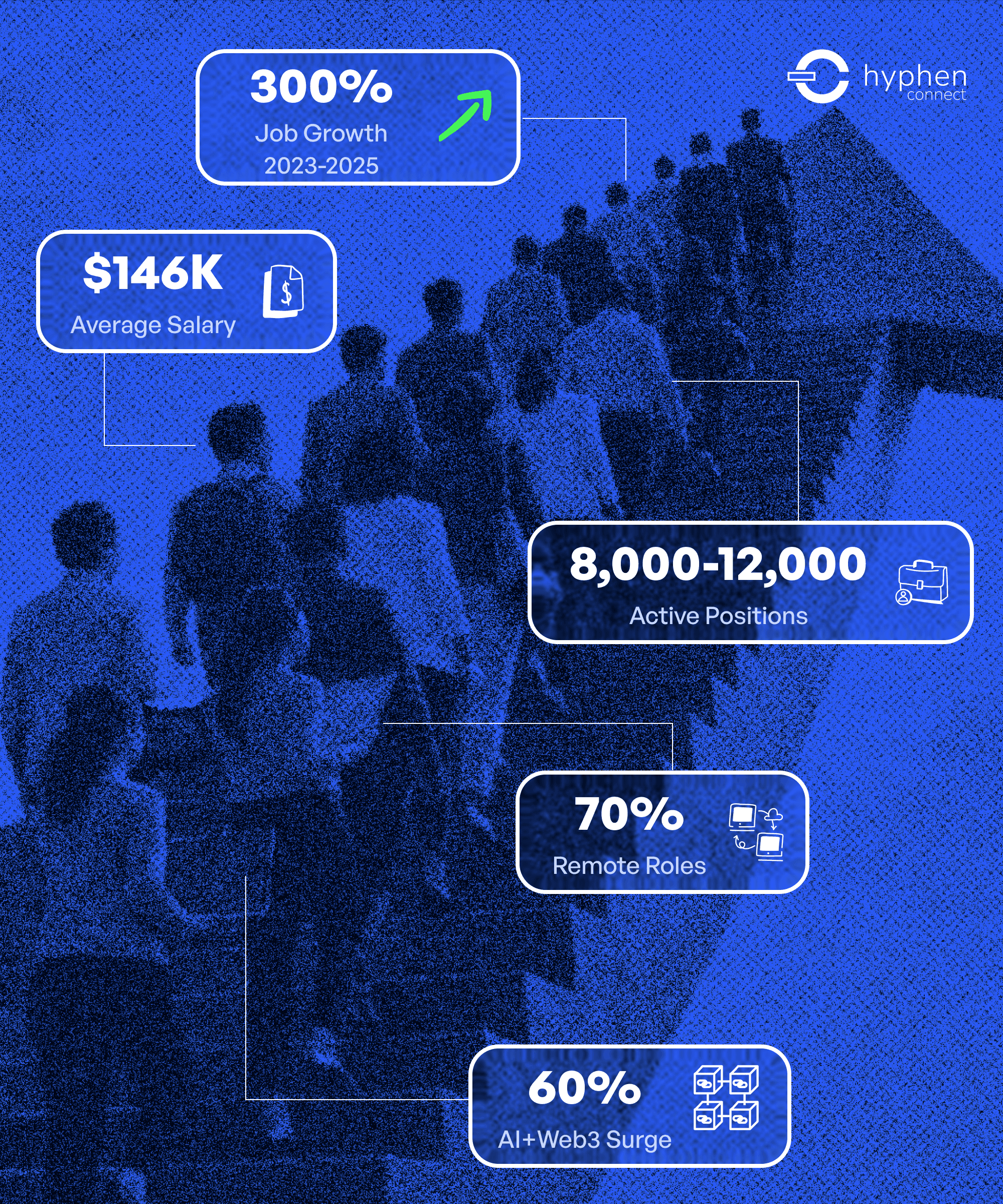
Web3 job postings hit all-time highs in 2025, with approximately 8,000 to 12,000 active global positions competing for talent at any given time. That represents a 47% rebound in hiring in 2025 alone, building on a staggering 300% surge in job openings from 2023 through 2025. According to data aggregated by Web3.Career analyzing over 80,000 job postings across 15,900+ companies, the talent war has never been fiercer.
For context: when crypto experienced its last major crisis—the FTX collapse in November 2022—hiring collapsed immediately alongside token prices. Companies went into survival mode. Engineers were laid off en masse. Job boards dried up within weeks.
Not this time.
Salaries Reflect Sustained Demand
Blockchain developers in the United States now earn an average of $146,250 annually based on analysis of over 1,000 positions by talent.com. Senior engineers command up to $187,000 to $200,000 in base salary, with many receiving significant token equity and performance bonuses on top. Entry-level developers—those with just basic blockchain fundamentals and smart contract experience—start at around $121,000, far exceeding typical software engineering salaries for junior positions.
The most specialized roles command even higher premiums. AI + Web3 integration engineers, who can bridge machine learning systems with blockchain protocols, earn between $140,000 and $250,000 according to RecruitBlock's 2025 hiring data. These hybrid roles barely existed two years ago. Now they represent some of the fastest-growing positions in the entire tech sector.
Perhaps most tellingly: traditional finance firms entering the Web3 space are paying up to 30% more than crypto-native startups for equivalent roles. When JPMorgan, BlackRock, and Fidelity compete for blockchain engineering talent, they're not betting on short-term token price movements. They're building permanent divisions that require permanent teams.
Competition Has Intensified
The hiring landscape has become brutally competitive. Some engineering positions at top protocols now receive up to 450 applications according to the Coincub Web3 Jobs Report. Companies that take longer than two weeks to make hiring decisions are losing top candidates to faster-moving competitors. The luxury of six-week interview processes—common during the 2021 bull market—is gone.
This hiring intensity persists despite market volatility. It persists despite regulatory uncertainty. It persists despite tokens losing 90% of their value. That persistence signals something deeper than a temporary hot market.
It signals structural change.
Why Institutions Are Betting on People, Not Tokens
The key to understanding this decoupling lies in institutional adoption—but not the kind of adoption crypto enthusiasts fantasized about for years. This isn't retail investors FOMOing into tokens. This is corporations and financial institutions treating blockchain as permanent infrastructure.
BlackRock's expansion into digital assets. JPMorgan's institutional crypto custody and trading operations. Fidelity's crypto services division. These aren't experimental marketing plays or speculative side bets. These are permanent business units requiring permanent talent. When a major financial institution hires a blockchain protocol engineer, they're not making a bet on next quarter's token prices. They're building internal capability that will compound over years.
Here's the critical insight: institutional players care about execution, not speculation. And execution requires talent.
Andreessen Horowitz's State of Crypto 5 report, released in October 2025, found that workers transitioning into Web3 now predominantly come from traditional finance, consulting, and enterprise technology backgrounds—not from failed crypto startups or laid-off traders. Since ChatGPT launched in November 2022, approximately 1,000 workers left crypto for AI startups. But in that same period, crypto gained roughly 1,000 professionals from traditional sectors, resulting in a net neutral talent exchange with AI while gaining ground against traditional finance and tech.
These aren't twenty-something crypto bros chasing token gains. These are professionals with 10+ years of experience in risk management, compliance frameworks, and enterprise software deployment. They bring systems thinking, regulatory expertise, and institutional discipline. They're building Web3 as infrastructure, not treating it as a speculation layer.
The Funding Data Confirms the Shift
Even as token prices remained volatile throughout 2025, venture funding into Web3 infrastructure continued flowing steadily. Notable funding rounds from October 2025 alone include:
- Allora Labs: $35 million for blockchain protocol development focused on incentivizing intelligence on-chain
- N3xt: $26 million for fintech infrastructure integrating blockchain rails
- TradeTalent: $8 million for AI-powered Web3 recruitment and skill verification—a company literally solving the talent shortage by building verification infrastructure
These aren't speculative seed rounds hoping for quick token flips. These are substantial Series A and growth-stage commitments to building durable platforms. And you cannot build durable platforms without durable teams.
The AI + Blockchain Merger Creates New Roles
Perhaps the most significant hiring driver is the convergence of artificial intelligence and blockchain technology. This merger has created entirely new role categories that barely existed 18 months ago.
Companies now need engineers who understand:
- Smart contract development and AI model deployment pipelines
- DeFi protocol mechanics and machine learning optimization
- Cryptographic security and neural network robustness
- Tokenomics design and AI agent economic frameworks
This hybrid skill set is extraordinarily rare. According to Outlier Ventures, hiring for AI + Web3 integrated roles increased 60% from late 2024 through 2025. The supply of qualified candidates hasn't kept pace with demand, creating a talent arbitrage opportunity that drives compensation upward regardless of token price volatility.
When your competitive advantage depends on engineers who can build AI agents that autonomously manage DeFi positions, you don't care if Ethereum is up or down 20% this week. You care about securing that talent before your competitors do.
The Structural Reasons Behind Decoupling
This separation between token prices and hiring demand isn't accidental. It reflects four fundamental changes in how Web3 companies operate:
1. Regulatory Clarity Enables Long-Term Planning
The Trump administration's embrace of cryptocurrency regulation—championing stablecoin legislation and pushing for clear digital asset frameworks—has created planning certainty that was absent during previous bear markets. When regulatory uncertainty reigned, crypto companies couldn't commit beyond quarterly burn rates. Hiring decisions were tactical, not strategic.
Now, with serious regulatory frameworks being debated in Congress and federal agencies providing clearer guidance, companies can make multi-year hiring commitments. You don't hire a senior protocol engineer on a six-month contract. When crypto founders suddenly believed in regulatory longevity, they finally invested in people as long-term assets rather than short-term expenses.
2. Mature Leadership Values Execution Over Sentiment
Early crypto teams were often founded by traders, retail investors, and speculators who viewed the business entirely through a token-price lens. If the token was up, they hired. If it was down, they cut. The company's success was measured in price action, not product metrics.
Today's Web3 founders increasingly come from traditional finance, cloud infrastructure, or enterprise software backgrounds. They measure success by:
- Daily active users and transaction volume
- Total Value Locked (TVL) and capital efficiency
- Developer adoption and ecosystem growth
- Protocol revenue and cash flow generation
These metrics don't move in perfect correlation with token prices. A Layer-1 blockchain's success is ultimately determined by network activity, developer mindshare, and real-world utility—not its token's 24-hour price chart. So hiring focuses on building that network activity, regardless of short-term volatility.
3. Remote-First Economics Reduce Overhead Risk
Web3 remains the most remote-first industry in technology. According to RecruitBlock's 2025 data, 70% of all Web3 job placements are fully remote. This structural difference allows companies to scale hiring globally without the geographic concentration risk of traditional venture-backed startups.
If your entire team is distributed across 15 countries with no expensive Silicon Valley office leases, you're not forced into dramatic layoffs when crypto winter hits. You can maintain stable core teams through volatility—something that was economically impossible for geography-dependent startups during the 2022 downturn.
Remote-first structure also creates global talent arbitrage opportunities. A protocol can hire world-class Rust developers from Eastern Europe or Southeast Asia at 40-60% of U.S. compensation while still paying above local market rates. This flexibility makes hiring decisions less sensitive to token price fluctuations.
4. Token-Based Compensation Aligns Incentives Long-Term
When employees receive significant compensation in protocol tokens with vesting schedules, they become aligned with long-term protocol success rather than daily price movements. A senior engineer earning $150K base salary plus 100,000 tokens vesting over four years doesn't panic-resign if the token drops 20% in a week. Their incentive is to build features and infrastructure that increase protocol utility and drive adoption over years.
This creates a virtuous cycle: better hiring → better product development → stronger protocol fundamentals → healthier long-term valuations regardless of short-term volatility.
Token-based compensation was initially seen as a way to conserve cash during bull markets. Now it's becoming a strategic alignment tool that reduces hiring volatility.
The Reality Check: It's Not Universal
Before we conclude that Web3 has fully matured and decoupled from speculation, honesty requires acknowledging: this decoupling is happening primarily at well-funded, institutionally-backed, and growth-stage companies. Not everywhere.
Early-stage crypto projects still face brutal hiring cycles when token prices collapse. Seed-stage teams depending heavily on token treasuries for runway still watch burn rates spike during bear markets. If your startup raised a Series A at peak euphoria in early 2024 based on inflated valuations, you've likely made painful cuts since then.
The decoupling phenomenon we're observing is most pronounced at:
- Institutional blockchain initiatives (JPMorgan Onyx, BlackRock's tokenization efforts, Fidelity Digital Assets)
- Well-capitalized protocols with $50M+ in stablecoin treasuries
- Established Layer-1 and Layer-2 networks with proven product-market fit
- AI + Web3 hybrid companies capturing significant venture interest
- Infrastructure and tooling companies serving the ecosystem
Smaller projects, meme tokens, and purely speculative protocols? They still live and die by token price. The difference is that these projects now represent a smaller percentage of total Web3 hiring than they did in 2021.
What This Means for Job Seekers
If you're considering a career in Web3 or blockchain development:
Specialize strategically. Generalist "crypto skills" are increasingly commodity-priced. But specialists in high-demand niches command premium compensation regardless of market conditions:
- AI + blockchain integration
- Zero-knowledge proof engineering
- Cross-chain interoperability protocols
- Regulatory compliance and legal engineering
- Smart contract security and auditing
Target institutional entrants. Traditional finance firms entering Web3 offer more stable compensation, better benefits, and less exposure to token volatility. They're also more likely to maintain hiring through market downturns.
Prioritize protocols with sustainable business models. Look for teams with diversified treasuries, real revenue generation, and proven product-market fit. Token price matters less when the underlying business generates cash flow.
What This Means for Employers
If you're hiring Web3 talent in 2026:
Hire now. Competition is fierce, but capital is flowing into credible projects. Waiting for "perfect market conditions" means losing talent to faster-moving competitors.
Build in public about your long-term vision. Top candidates now vet potential employers based on sustainability, not token hype. Show that you're thinking in terms of years, not quarters.
Offer competitive base salaries. Token upside is attractive, but professionals with families need stable base compensation. The days of paying 70% in tokens and 30% in cash are over for senior roles.
Streamline your interview process. If you can't make hiring decisions within two weeks, you're losing candidates. Top engineers are receiving multiple offers simultaneously.
What This Means for the Industry's Future
If this decoupling trend continues—and all structural evidence suggests it will—the implications for Web3's future are profound.
The Talent War Defines 2026
The defining competition in blockchain this year won't be which Layer-1 has the fastest transactions or which DeFi protocol has the cleverest incentives. It will be which teams can attract and retain the best engineering talent.
Talent compounds over time. Great engineers build great products. Great products attract users and developers. Network effects create moats that token prices eventually reflect. But it starts with people.
According to Web3.Career's Intelligence Report analyzing hiring patterns through late 2025, the most successful protocols share a common trait: they hired aggressively during market downturns when competitors were cutting costs. Those teams are now shipping products that define the next cycle.
Traditional Finance Integration Accelerates
The influx of traditional finance professionals into Web3 isn't slowing down. If anything, it's accelerating. These professionals bring:
- Institutional compliance frameworks
- Risk management discipline
- Capital markets expertise
- Regulatory navigation skills
As Web3 protocols increasingly interact with traditional financial systems—through tokenized securities, real-world asset (RWA) protocols, and institutional DeFi—this traditional finance talent becomes essential infrastructure, not a nice-to-have.
Remote Work Becomes Permanent Competitive Advantage
Web3's 70% remote placement rate isn't temporary. It's structural. And it creates a permanent arbitrage opportunity against traditional finance and tech companies mandating return-to-office policies.
When Goldman Sachs requires five days per week in Manhattan offices, crypto protocols offering fully remote positions can poach their best blockchain engineers with minimal salary increases. Geographic flexibility is now a primary retention tool.
AI + Blockchain Defines the Next Decade
The convergence of artificial intelligence and blockchain technology is still in its earliest innings. Current use cases—AI agents executing on-chain transactions, machine learning models optimizing DeFi strategies, AI-driven smart contract auditing—are just the beginning.
The teams that win the next decade will be those who successfully merge these technologies. And those teams will be built by engineers who understand both domains deeply. The 60% hiring surge in AI + Web3 roles is likely just the start of a much longer trend.
The Path Forward: Maturity Looks Like Boring Hiring
If blockchain and Web3 are truly maturing industries, we should expect hiring to become... less dramatic. Fewer viral stories about twenty-something engineers making eight-figure token windfalls overnight. More quietly competent professionals building protocol infrastructure over years.
Higher salary floors. More standardized equity and token compensation packages. More conventional benefits and career progression frameworks. More boring HR processes.
That's not a sign of decline. That's what growth looks like in maturing industries.
When an industry matures, exceptional talent becomes the norm rather than the exception. Hiring becomes predictable rather than feast-or-famine. Compensation becomes competitive but rational rather than wildly volatile. The fact that Web3 companies now maintain hiring through market downturns—rather than panicking and cutting teams back to "year zero"—suggests the industry has crossed a critical threshold.
Traditional technology companies hire through recessions. Financial services firms scale teams through market downturns. They do this because they understand that talent compounds over years, while quarterly volatility is just noise.
Web3 is finally operating the same way.
Conclusion: The Most Important Metric of 2026
Token crashes and hiring booms aren't paradoxes in mature industries—they're the standard operating model. Amazon hired aggressively through the 2000s even as its stock price remained volatile. Apple built its iPhone team during periods when the stock was flat. Google scaled engineering through multiple market cycles.
They understood something fundamental: building transformative technology requires exceptional people, and exceptional people are available regardless of market timing.
Web3 has finally internalized this lesson.
Prices will continue to swing wildly. Tokens will pump and dump. Speculation will remain a feature of crypto markets for the foreseeable future. But the companies building the infrastructure layer of Web3—the protocols, tools, and platforms that will power the next decade of blockchain adoption—aren't waiting for perfect market conditions anymore.
They're capturing talent today. Building products tomorrow. And trusting that strong fundamentals eventually drive value, regardless of short-term volatility.
The most important crypto metric in 2026 won't be Bitcoin's price, Ethereum's gas fees, or which altcoin pumps hardest during the next bull run.
It will be how many world-class engineers, compliance experts, and product builders your favorite protocol can attract and retain.
That's the metric that predicts long-term success. And right now, that competition has never been fiercer—token prices be damned.
Want more Web3 hiring insights?
We publish weekly analysis on blockchain careers, talent trends, and what's really happening in the market.
👉 Join our Telegram for daily updates
👉 Follow on Linktree for all our socials