

Hyphen Pulse: November 2025
The Market Crashed. Hiring Didn't. Here's Why That Changes Everything for 2026.
By Hoven Cheung, Founder, Hyphen Connect
Published: November 30, 2025
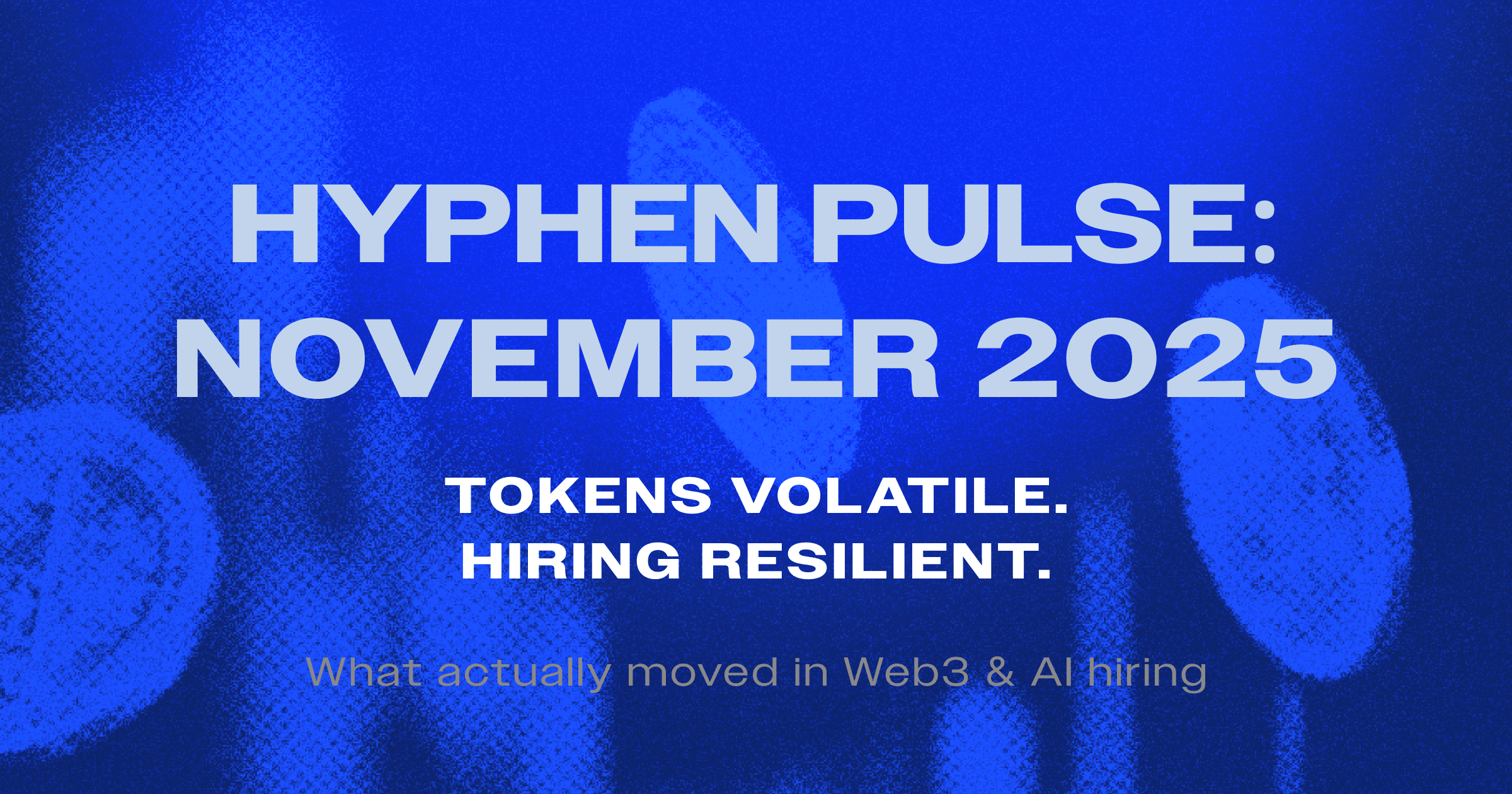
Bitcoin crashed 30% in November. Crypto ETFs saw $3B in outflows. Fear sentiment hit 17/100.
But here's what the headlines missed:
- Lighter (perpetual DEX) raised $68M at a $1.5B valuation—while profitable
- AI startups raised $3.5B in November alone (Physical Intelligence $600M, Cursor $2.3B)
- Web3 hiring stayed resilient: compliance roles +35%, AI-Web3 hybrids +60%, zk engineers +51%
The data is clear: The talent market has decoupled from the token market.
And if you're planning 2026 hiring, this is the inflection point you need to understand.
This report breaks down:
- What actually moved in November (markets vs. talent)
- The 3 Web3 roles that take 6-12 months to fill (start recruiting now)
- Why AI-Web3 convergence is the top-1% opportunity
- Our 2026 predictions (and what founders should do today)
Let's dig in.
1. The Split: Tokens Whip, Teams Rebalance
Thesis: Capital rotated in November. It didn't disappear. And the teams that adapted are winning.
What Happened in November
On the crypto side:
- Bitcoin wicked to $82K (−30%), then recovered to $95K
- Crypto ETFs saw $3B in outflows
- Fear sentiment collapsed to 17/100
On the capital side:
- Lighter: $68M at $1.5B valuation (profitable perpetual DEX)
- CFTC approval: leveraged spot crypto trading coming December (institutional rails)
- Coinbase token sales: first sale (Monad) live Nov 17–22
- AI funding: $3.5B+ in November (Physical Intelligence $600M, Luma $900M, Cursor $2.3B)
Tech layoff tally: 118K+ in 2025 (Intel 21K, Amazon 14K, Meta 100+), but AI-exposed sectors grew ~27% revenue per employee.
What This Actually Means
The capital stack rotated. It didn't disappear.
Teams that were reactive in 2024 are now selective in 2025. They're:
- Hiring later in funding cycles (not day-one headcount bloat)
- Focusing on A-players and niche roles (not generalists)
- Paying premium comp for hard-to-find talent (zk, compliance, AI-Web3 hybrids)
Result: If your 2026 hiring strategy is the same as 2024's, you'll get beaten by founders who adapted.
2. Web3 Hiring Pulse: Scarcity at the Edges
Thesis: The hardest roles didn't get easier—they got more selective.
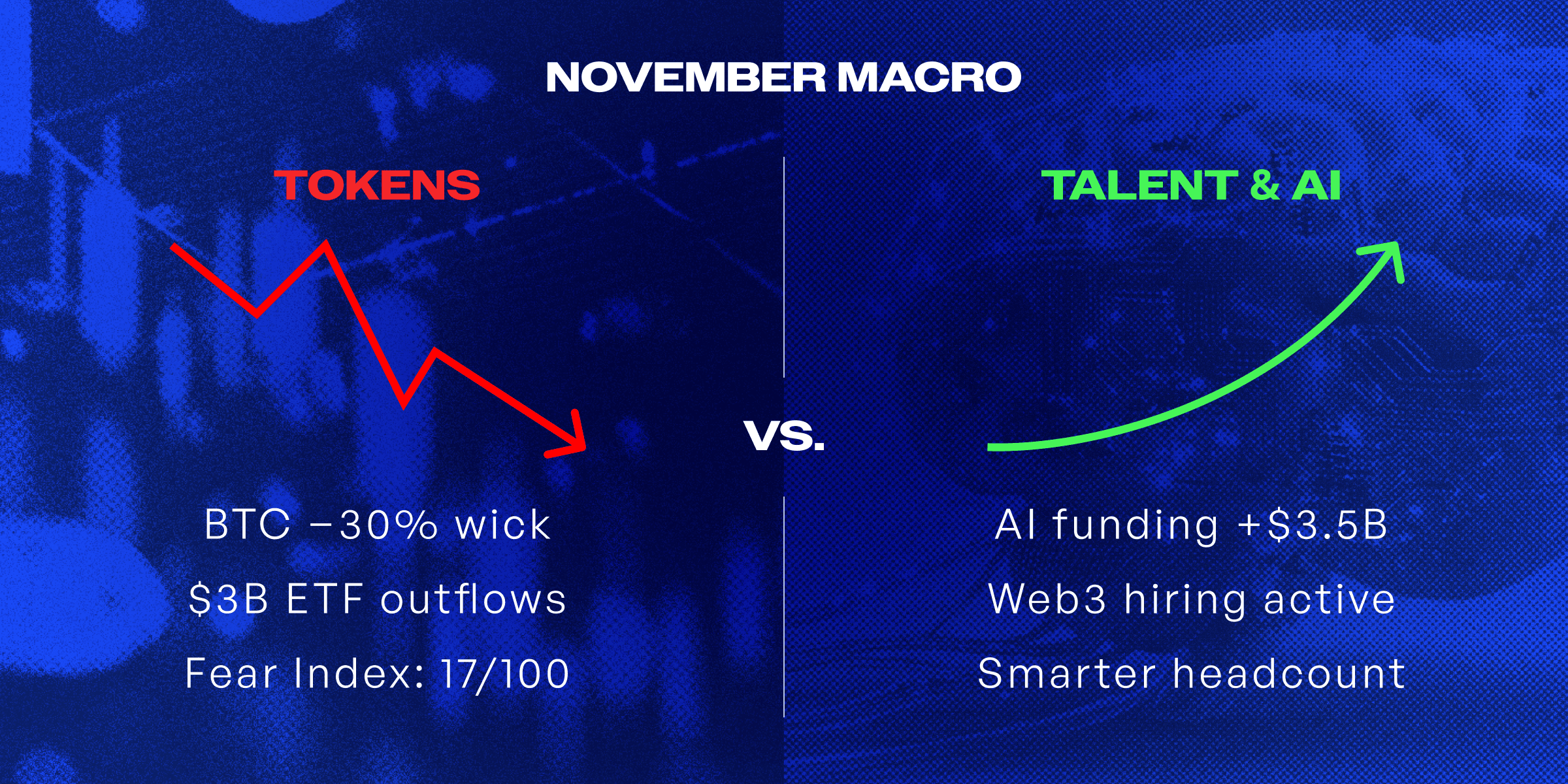
Three signals stand out when you strip away token noise:
2.1 zk Engineers: From Nice-to-Have to Bottleneck
The Data:
- Demand: +51% YoY (highest scarcity of any Web3 role)
- Search time: 6–12 months is normal, not a failure
- Drivers: L2 scaling, zk-rollups, privacy protocols
What Founders Tell Us:
"We need a zk engineer in Q1 2026."
Our response: "You should have started recruiting in October."
Why It Matters:
If zk is on your roadmap, the question isn't "Should we hire?" It's "When do we start?" The answer is: earlier than you're comfortable with.
Pro tip: Start with part-time advisors or research collabs in Q4 2025. Build relationships before you need to fill.
2.2 Compliance & Legal: Unglamorous, Impossible to Hire
The Data:
- Demand: +35% YoY
- Drivers: MiCA (Europe), SEC scrutiny (US), emerging regulatory frameworks
- Average time-to-hire: 4–6 months (senior roles often 6–9 months)
- Market reality: Most compliance talent is locked in at big enterprises; candidates with multi-jurisdiction exp are 2x harder to find
What We're Seeing:
Founders who delayed compliance in 2024 are now:
- Paying 40–60% premiums for any candidate with MiCA + US experience
- Running solo searches for 6+ months and still coming up empty
- Treating compliance as part of go-to-market architecture (finally)
What This Means:
Compliance isn't a box to tick post-launch. It's a hiring cycle that needs 6 months runway. If you're raising in Q1 2026, your compliance hire should already be in process.
2.3 Remote-First Web3: The Geo Arbitrage Play
The Data:
- 90%+ of Web3 roles are remote-first globally
- APAC talent = 30–40% cost savings vs. Bay Area, while paying 50–100% above local medians
- Hyphen's network: 80K+ talents across APAC, Europe, global; 90%+ remote
The Reality:
If you insist on SF/NYC-only hiring, you're competing for ~10% of the available talent pool.
If you open to remote + APAC, you unlock:
- Senior protocol engineers at $150–200K (vs. $200–280K in SF)
- Compliance specialists who know HK/Singapore regulatory landscape
- Proven founders and operators who've lived through 2022 bear market and stayed
For APAC Founders:
You already have this advantage. Use it to hire globally while maintaining cost discipline.
2.4 What We're Tracking for December 2025
Based on our pipeline of 40+ active searches:
- Engineering & Technical Roles: 29 open roles
- BD & Sales Roles: 14 open roles
- Finance, Accounting & Audit Roles: 13 open roles
Forecast: If current trends persist, the majority of new roles will be in engineering/tech, followed by business development and finance. Bulk hiring for certain functions (engineering, finance) will likely continue.
3. AI Hiring Pulse: Smarter Headcount, Hybrid Talent Explosion
Thesis: AI hiring is becoming more selective, and hybrid AI-Web3 roles are a top-1% opportunity.
Signal #1: Revenue per Employee Is Up, Not Just Headcount
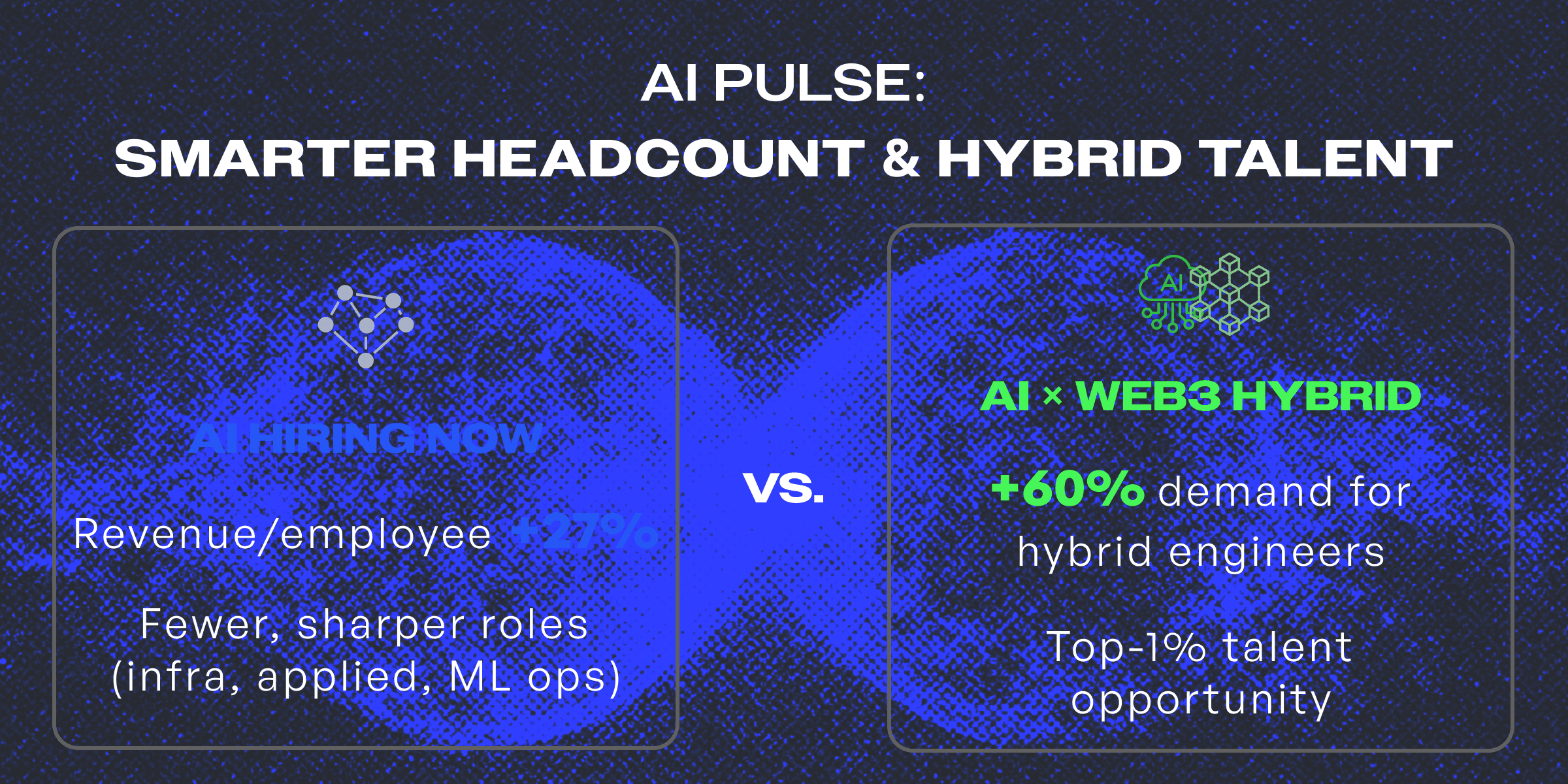
AI-exposed sectors saw ~27% revenue per employee growth, meaning:
- Teams are not hiring "AI engineer" benches
- They're laser-focused on platform/infra, applied roles with product ownership, and ML ops where it unlocks usage
- Fewer roles, but more senior, more specialized
Translation for 2026:
If you're hiring an "AI engineer," you're probably hiring wrong. If you're hiring "a machine learning systems engineer for on-chain analytics" or "an ML ops lead to optimize our inference pipeline," you're thinking right.
Signal #2: AI × Web3 Hybrid Roles Are a Top-1% Opportunity
The Data:
- Demand: +60% for hybrid AI–Web3 engineers
- Definition: People who can ship AI-powered smart contracts, on-chain ML, agentic infrastructure, or DeFi + ML integrations
- Scarcity: Extreme (most candidates specialize in one domain)
Why It Matters:
If you're one of 500 people on Earth who can:
Fine-tune LLMs and understand smart contracts, or
Build ML infra and ship on-chain analytics, or
Deploy agents that interact with DeFi protocols
…you're in the top 1% of the candidate market, with +60% demand backing you and 2–3 opportunities available per week.
For founders: This is a category to cultivate now through advisors, part-time projects, and early relationships—not a role to panic-open in 6 months.
4. Proof from the Field: How Hyphen Helped Mamori Hire for Web3's Hardest Role
MEV engineering sits at the intersection of quantitative trading, blockchain infrastructure, ML systems, and low-latency execution. It's arguably the hardest role to hire in Web3.
When Mamori—an ML-enabled pathfinder for blockchain value extraction—needed to scale their team, they faced a familiar problem: high mismatch from direct inbound. Many candidates failed the first round, and screening time ballooned.
The Challenge
Mamori isn't hiring generalist blockchain devs. They need people with systems depth and transfer-learning chops:
- EVM internals (opcodes, storage layouts, bytecode reading)
- Rust systems programming
- DeFi economics and mechanism design
- Binary analysis and adversarial modeling
- Strong math/CS fundamentals with ML optimization concepts
As founder Andy M. Lee puts it: "The through-line is adversarial thinking and the ability to explain one domain clearly while connecting it to another."
Red flags that signal misfit: narrow tool-only security experience, "I only do X, not Y" mindset, resistance to documentation or code review, or purely mercenary motivation.
What Hyphen Did
Hyphen built a curated pipeline mapped to Mamori's research-driven bar and the specific roles needed (Rust systems, on-chain research, ML/LLM infra).
Instead of flooding the funnel with volume, we focused on:
- Zero-based intake: Clarified what problems needed solving not just "MEV researcher" but "someone who can surface exploit paths and reason about state transitions"
- Proof over pedigree: Screened for open-source contributions, exploit write-ups, and adversarial thinking
- Technical alignment: Ensured candidates understood CFG-guided search, state-aware detection, and cross-domain transfer before reaching the founder interview
The Results
- Time-to-shortlist: Days, not weeks
- Time-to-offer: 2–6 weeks (vs. industry standard of 6–12 months for MEV roles)
- Percentage of hires via Hyphen: ~60% of Mamori's current team
- 6-month retention: ~83.3%
Andy's take: "Hyphen uniquely matched our demand with the right people—and advised through hiring and post-employment HR strategies."
Mamori's current headcount is 11, with plans to expand Security Research and Growth roles in Q1 2026.
Why This Matters for Founders
Speed isn't about "how fast can we post." It's about "how fast can we decide and execute."
Most teams skip the alignment step—clarifying what problems the hire solves, what success looks like, and what attributes to screen for—and then wonder why they're interviewing 100 people for one role.
Mamori's funnel shows what tight alignment produces:
- Founder interview pass rate: 67.9%
- Written technical task pass rate: 30.6%
- Technical presentation pass rate: 63.6%
- Net interview-to-offer rate: ~13.2%
That's a high-signal, low-noise process. And it starts with defining the bar before you open the search.
Read the full Mamori case study: hyphen-connect.com/blog/mamori-founder-qa-ml-pathfinder-web3-security
5. What This Means for Founders Planning 2026
Three concrete actions:
5.1 Start zk, Compliance, and AI–Web3 Hiring in Q4 2025 or Early Q1 2026
These roles take 6–12 months:
- zk: global talent pool of ~200–500 people who can actually execute
- Compliance (multi-jurisdiction): even smaller pool
- AI–Web3 hybrid: nascent category, extreme scarcity
Decision matrix:
- If these roles are "nice-to-have" → hire in Q2 2026
- If these roles are core to your roadmap → recruiting now, hiring in Q1 2026
- If these roles are launch-blocking → should have started in August
5.2 Design Your Team Before You Write the JD (Zero-Based Hiring)
Process (takes 1–2 weeks, saves 6 months):
- Clarify the problem: "What is this hire meant to solve?"
- Define success: "How will we know if they succeeded? Metrics?"
- Align internally: "Who owns what? What are the boundaries?"
- Build the scorecard: "What attributes do we actually screen for?"
Example:
Bad: "We need a Growth Lead"
Good: "We need someone to own user acquisition, understand on-chain data analysis, and report to the CEO. Success = 10K DAU by Q2 2026. We'll screen for: Web3 builder experience, SQL fluency, and founder mentality."
5.3 Use Remote + APAC as a Feature, Not a Compromise
Action:
- Open your spec to remote from day one (90%+ of Web3 is remote anyway)
- Actively recruit in APAC (HK, Singapore, Bangkok, Manila) for roles where it makes sense
- Build async processes (time zones are a feature if you embrace them)
Result:
- Access to 80K+ qualified talent (Hyphen's network alone)
- 30–40% cost savings on senior roles
- Talent that's lived through bear markets and stayed
6. What This Means for Talent
6.1 Proof Beats Pedigree
Founders screen hundreds of resumes a week. What cuts through:
- Open-source contributions: PRs you can read
- Incident reports: Postmortems you led
- Case studies: Before/after metrics (not just "responsibilities")
- GitHub/Notion portfolio: Real code, shipped projects
Your CV might list "Senior Engineer at Coinbase." Your GitHub, shipping proof, and incident write-up are what get the interview.
6.2 Hybrid Skills Are Leverage
If you're working at the intersection of AI + Web3, you're in a top 1% opportunity slot:
- +60% demand growth
- 2–3 opportunities available per week
- 40–60% premium comp vs. single-domain specialists
Lean into this. Learn Solidity + LLMs. Understand on-chain analytics. This is the bet for 2026.
6.3 Corrections Are Entry Windows
Paradox of Web3 talent markets:
- Token prices down → talent market stays strong
- Everyone else panicking → strong projects still hiring
If you've been waiting on the sidelines for "better times," the best time is when everyone else is distracted. That's now.
7. 2026 Predictions: What We're Watching
Based on our data from 700+ placements and 40+ active projects, here's what we expect in 2026:
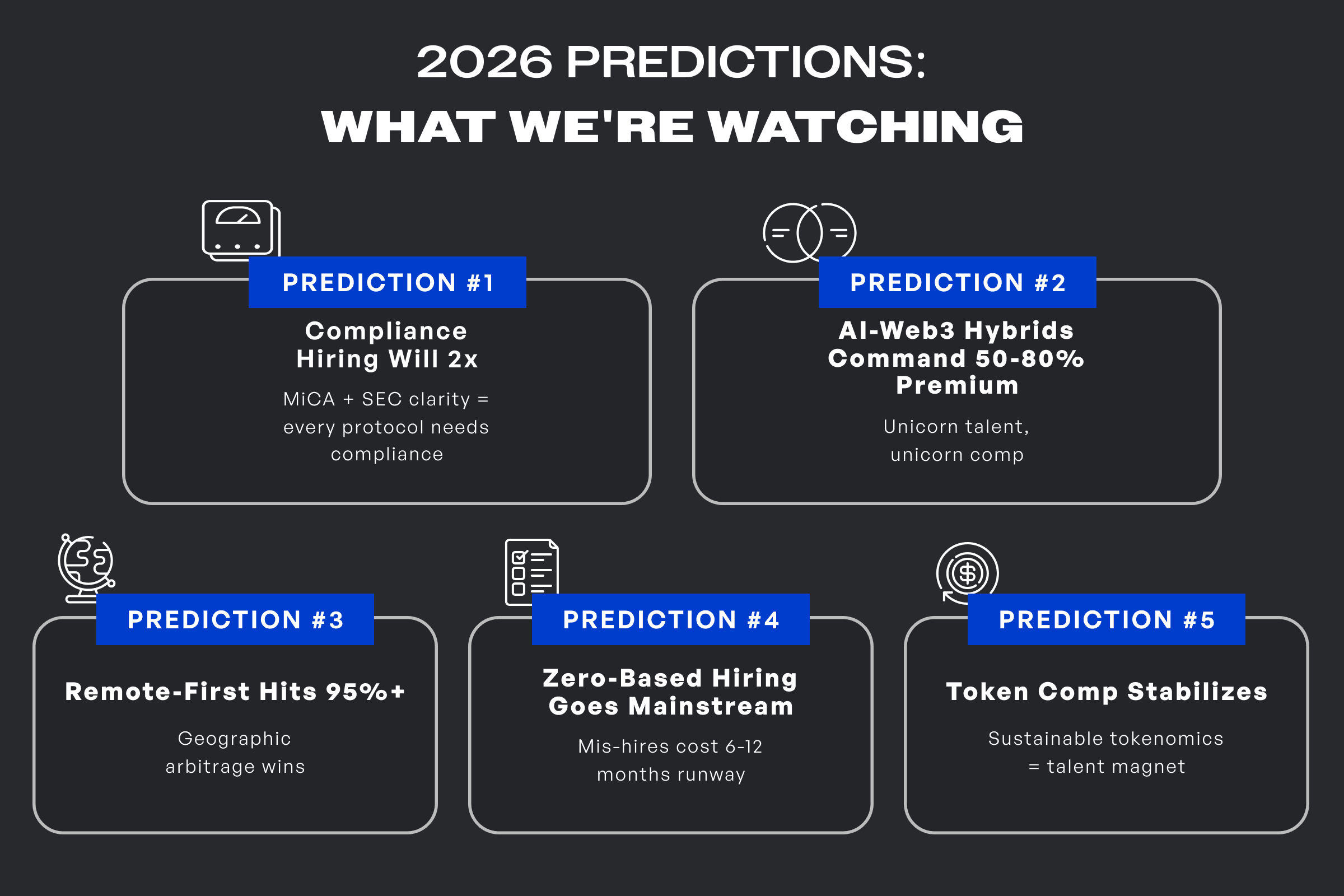
Prediction #1: Compliance Hiring Will 2x (Again)
Why: MiCA enforcement starts Jan 2026. SEC clarity post-GENIUS Act. Every protocol raising >$10M will need in-house compliance.
What to do: If you're fundraising in H1 2026, start recruiting compliance now. Average time-to-hire: 6-9 months.
Prediction #2: AI-Web3 Hybrids Will Command 50-80% Premium
Why: Demand +60% in 2025, but supply hasn't caught up. Candidates who can ship LLMs + smart contracts are unicorns.
What to do (Founders): Hire adjacent talent (strong AI or Web3) and train the other domain internally. Don't wait for the "perfect" candidate.
What to do (Talent): If you're in AI, learn Solidity. If you're in Web3, learn LangChain. You'll 2x your comp.
Prediction #3: Remote-First Will Hit 95%+ for Web3 Roles
Why: Geographic arbitrage is too compelling. APAC talent = 30-40% cost savings, proven track record.
What to do: If you're not hiring remote + APAC by default, you're losing to competitors who are.
Prediction #4: "Zero-Based Hiring" Becomes Industry Standard
Why: Mis-hires cost 6-12 months of runway. Founders who skip alignment lose.
What to do: Adopt zero-based hiring (clarify problem → define success → align internally → build scorecard). Hyphen can help.
Prediction #5: Token Comp Will Stabilize (But Won't Disappear)
Why: Regulatory clarity means tokens can generate revenue. Projects with sustainable token economics will win talent.
What to do: If you're offering tokens, explain the model (vesting, unlock schedule, revenue mechanics).
8. How Hyphen Connect Helps
We are Hyphen Connect:
- APAC-native Web3 & AI talent partner
- 700+ placements | 40+ active projects | 80K+ talents in network
- Remote-first, operator-led, founder-focused
- Average time-to-hire: <21 days for AI roles, 10 weeks for zk/compliance
If you're a founder planning 2026 hiring:
- Book a Zero-Based Hiring Workshop (free, 30-60 min) → DM "2026 Workshop" on LinkedIn or X
- Submit an Intake Form → https://hyphen-connect.com/web3-talents
If you're a candidate in Web3 or AI:
- Submit Your Profile → https://hyphen-connect.com/careers/express-interest
- Explore our opportunities → https://hyphen-connect.com/careers
- Stay Connected → https://linktr.ee/hyphenconnect
Hyphen Pulse is our monthly intelligence drop on hiring signals, talent trends, and what founders actually need to know.
About the Author
Hoven Cheung is the founder of Hyphen Connect, an APAC-native Web3 & AI recruitment partner. Before starting Hyphen, Hoven spent 5+ years building talent functions at Web3 startups including Animoca Brands, Hailstone Labs, and Neat. He's placed 700+ candidates across 40+ projects and believes hiring is a strategic function, not a headcount game.