

Introduction: Why Negotiating Your Web3 Salary Matters More in 2026
The Web3 job market in 2026 will look very different from the hype cycles of previous years. As regulation firms up and institutional players deepen their exposure to digital assets, crypto and blockchain companies are being pushed to behave more like mature, long-term businesses. That shift is changing how compensation is structured, benchmarked, and negotiated.
For candidates, this is good news. There is more salary transparency, clearer role definitions, and stronger competition for specialized talent. But it also means expectations are higher, and hiring teams are more disciplined around budgets and offers. Going into 2026, simply “seeing what they offer” is no longer enough. You need a clear plan for how to negotiate your Web3 salary, understand tokens and vesting, and evaluate risk versus upside before you sign.
Understanding a Web3 Compensation Package in 2026
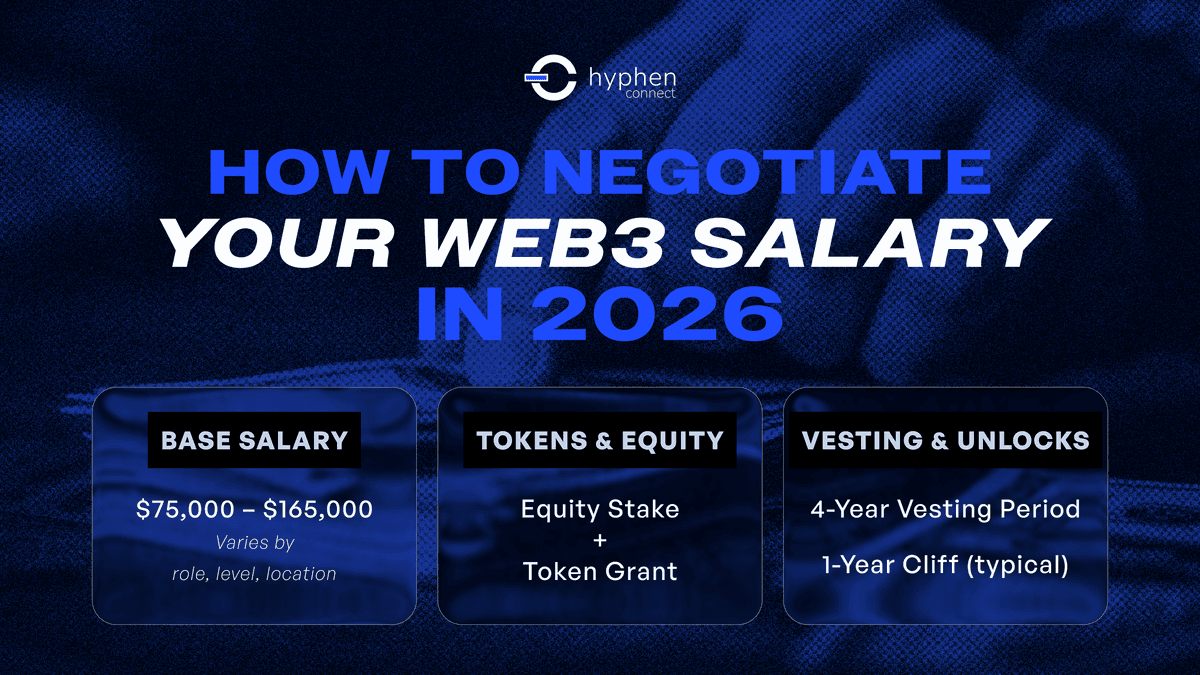
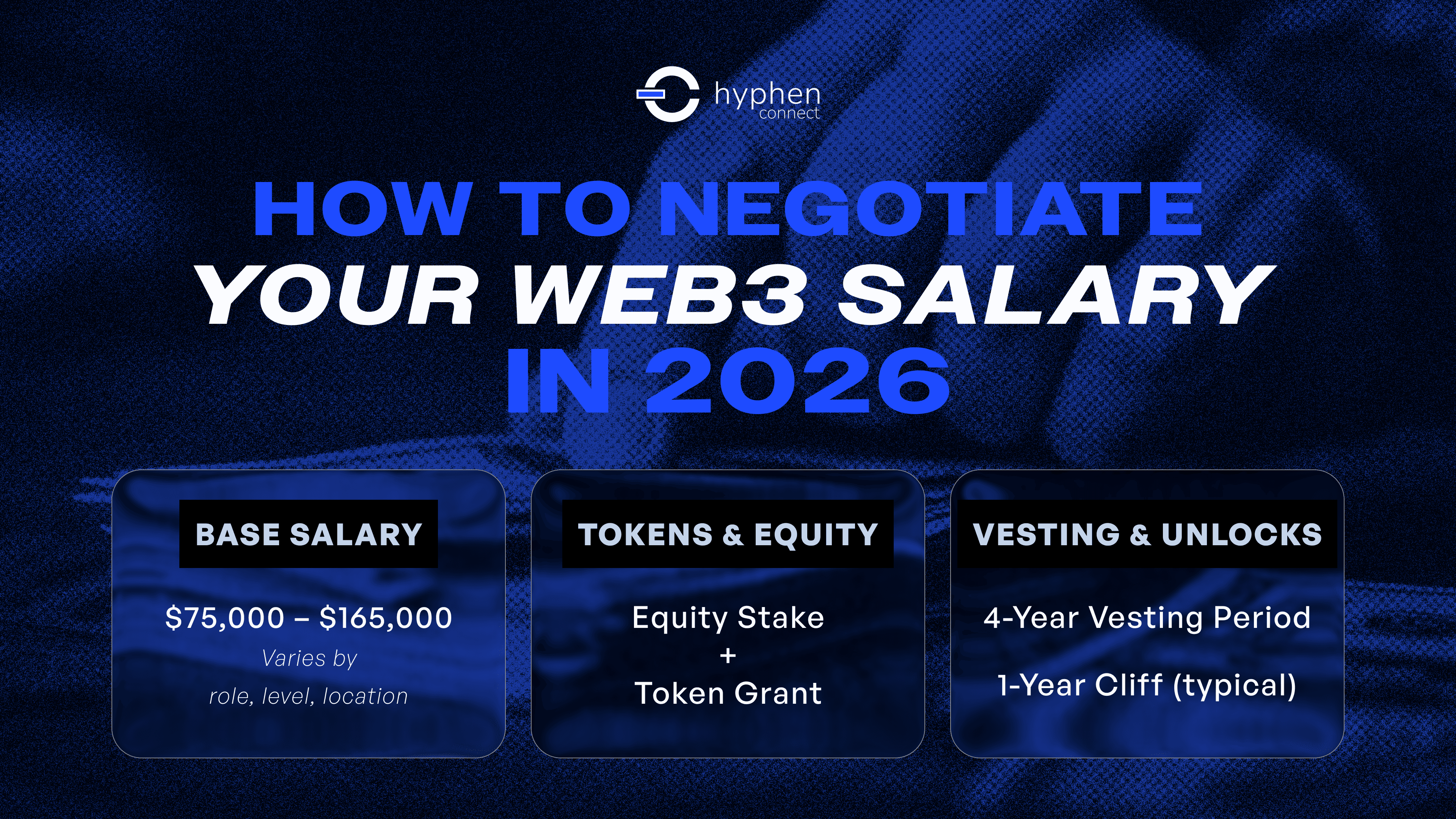
Before you talk numbers, you need to understand what is actually on the table. Web3 compensation usually includes three main components: base salary, token or equity allocation, and vesting schedule. Each one affects your real earnings and risk profile.
Base Salary: Your Foundation
Your base salary is the most stable part of your Web3 compensation and should be the first thing you benchmark. For many Web3 engineering roles, ranges still often fall roughly in the mid–five to low–six figures depending on location, seniority, and stack. For non-technical roles in marketing, operations, and community, ranges can be a bit lower but are trending upward as the market matures.
Because more jurisdictions now enforce salary range disclosure and pay transparency, candidates in 2026 have better data than ever. Use that to your advantage. Go into interviews with a clear minimum acceptable base salary and a realistic target band, backed by data from multiple sources rather than gut feeling.
Tokens and Equity: Upside and Volatility
The biggest difference between negotiating a Web3 job and a traditional tech job is the token and equity component. This is where much of the potential upside lies—along with most of the risk.
Common structures include:
- Company tokens: Often allocated based on level and role, and tied to a vesting and unlock schedule.
- Equity or token-wrapped equity: Ownership stakes in the entity behind the protocol or product.
- Hybrid packages: A mix of equity and tokens, sometimes with performance-based boosters.
Key points to clarify when you negotiate:
- What percentage of the total token or equity pool your grant represents.
- Whether tokens are already liquid, will be launched in the future, or are subject to additional lock-ups.
- How the company handles token volatility when it comes to employee compensation (e.g., are any parts stabilized in stablecoins?).
Vesting & Unlocks: When You Actually Get Paid
Even a generous token or equity number can be misleading if you do not understand vesting and unlock schedules. In Web3, these details matter a lot.
You should always ask:
- What is the vesting period? Many packages follow a 4-year vesting schedule, sometimes with a 1-year cliff. Others experiment with shorter periods for critical hires.
- What is the cliff? The cliff is when any of your grant vests for the first time. Before that date, you effectively have nothing.
- Are there additional unlocks after vesting? Some tokens vest to you but remain non-transferable for a period. That adds another layer of risk.
When you negotiate, you are not only negotiating “how much” you receive, but also how quickly and how reliably you will receive it.
The 2026 Web3 Job Market: Context for Your Negotiation
Negotiation does not happen in a vacuum. Understanding where the market is heading in 2026 will help you frame your expectations and your leverage.
A More Mature, Competitive Market
Crypto companies are increasingly operating like traditional tech and fintech businesses. With larger treasuries, deeper institutional involvement, and clearer regulatory frameworks, more teams are formalizing their compensation structures instead of improvising them.
For candidates, this means:
- More structured salary bands by level and region.
- Clearer titles and expectations (e.g., “Protocol Engineer L2” vs “Blockchain Wizard”).
- More standardized token and equity policies.
The flip side: hiring managers are under greater pressure to stick to budgets. Strong negotiation is still possible—but you need to justify your ask with clear value.
Specialization Is Driving Premiums
The most sought-after profiles in 2026 are no longer just “Web3 developers” in general. Employers are increasingly searching for:
- Security-focused engineers and auditors
- Engineers at the intersection of AI and blockchain
- Compliance, legal, and risk professionals familiar with Web3
- Senior protocol and infrastructure engineers
- Growth, partnerships, and BD leaders with proven track records
If you fall into one of these categories, you likely have more leverage than you think. Specialization, demonstrable impact, and reputation in the ecosystem can justify meaningful premiums over “median” offers.
Remote Work Is the Default, Not the Perk
Remote work remains deeply embedded in the Web3 culture, but it has also become normalized. That means:
- Companies expect global candidates and have frameworks for regional salary adjustments.
- You can often negotiate location flexibility in exchange for other concessions.
- Time zone overlap and availability may still be part of the conversation.
When you approach negotiations, remember that remote work is now part of the baseline in many roles. Do not trade away too much compensation for what is already standard in the industry.
Step-by-Step Playbook: How to Negotiate Your Web3 Salary in 2026
This is the heart of your preparation: a practical, repeatable process you can apply to any Web3 job offer.
1. Do Your Homework Before You Talk Numbers
Effective negotiation starts long before you receive an offer.
- Research salary ranges for your role, level, and region using multiple data sources.
- Map your skills to market demand: if you have skills in security, zero-knowledge, DeFi, or compliance, note that explicitly.
- Understand the company’s stage: early-stage startups, growth-stage protocols, and established exchanges all structure compensation differently.
Your goal is to walk into the process with a clear, data-backed range—your ideal target, your acceptable band, and your walk-away point.
2. Build Your “On-Chain Resume”
In Web3, your portfolio extends beyond a PDF.
Strengthen your negotiation position by documenting:
- Smart contracts you have deployed or contributed to
- DAOs, protocols, and communities where you are an active contributor
- Public governance proposals, audits, or research you authored
- Open-source contributions, GitHub repos, or hackathon wins
When you negotiate, referencing concrete on-chain or public contributions gives your claims of impact and seniority real weight.
3. Anchor the Conversation with a Value-Driven Range
When the company asks about your expectations, resist the urge to undersell yourself or answer with “I’m open.” Instead:
- Present a range, not a single number.
- Base that range on your research and the value you can bring, not on your current salary.
- Tie your expectations to outcomes: “Given my experience shipping X and Y, and current benchmarks for this role, I’m targeting a total compensation range of …”
Anchoring the conversation with a confident, well-reasoned range sets the tone for the rest of the negotiation.
4. Negotiate the Full Package, Not Just the Base
In Web3, almost every component of your package is negotiable in some way:
- Base salary: If a company is constrained on base, they may have more flexibility elsewhere.
- Token / equity grant size: Ask how your grant compares to others at your level. Clarify whether increasing it is possible.
- Vesting and cliffs: For senior or critical roles, it is often reasonable to request a shorter cliff or partial acceleration on certain milestones.
- Bonuses and stablecoins: Consider asking for performance bonuses or a portion of your compensation in stablecoins for income stability.
Approach the negotiation like designing a portfolio: aim for a mix of security (base + stablecoins) and upside (tokens + equity) that matches your risk tolerance.
5. Ask Smart, Specific Questions
The questions you ask during negotiation both protect you and signal your sophistication. Examples:
- “Can you walk me through the tokenomics and where the employee pool fits into it?”
- “What is the exact vesting schedule for both equity and tokens? Are there additional lock-ups or unlock schedules?”
- “How is my grant affected by future fundraising rounds or token launches?”
- “How do you handle token volatility when it comes to employee compensation over time?”
Thoughtful questions can surface hidden risks and help you compare offers more accurately across companies.
6. Use Leverage Ethically and Transparently
If you are interviewing with multiple companies, leverage that—but do it respectfully.
- Do not fabricate offers or ranges.
- Be honest about your timelines and where you are in other processes.
- If another offer is significantly stronger, share the broad outline and ask if your preferred company can come closer, especially on the base or stability components.
Companies in 2026 expect top candidates to have options. Handling that dynamic professionally will often strengthen rather than weaken their perception of you.
7. Get Everything in Writing
Before you sign anything, make sure all the following are clear and documented:
- Base salary and currency
- Bonus structure (if any)
- Token and/or equity grant size, type, and instrument
- Vesting schedule, cliff, and any acceleration clauses
- Unlock schedules or additional lock-ups for tokens
- Any location, remote work, relocation, or visa-related commitments
Verbal promises are not enough—especially in a volatile, fast-moving industry. A clear, written offer protects you and sets expectations on both sides.
Red Flags to Watch When Negotiating Web3 Compensation
Not every opportunity is worth the risk, no matter how exciting the technology sounds. Be cautious if you see:
- 100% token-based compensation with no stable salary component.
- Very large token promises with no transparent tokenomics or vesting details.
- Reluctance to put details in writing or answer basic questions about structure.
- No regulatory or compliance awareness in jurisdictions that clearly require it.
- Pressure to accept quickly without time to review or compare.
In 2026, you should expect a minimum level of professionalism and structure from any serious Web3 employer.
A Simple Timeline to Prepare for the 2026 Web3 Job Market
To make this actionable, here is a high-level timeline you can follow from now into 2026:
December – January:
Research salary benchmarks, update your resume and on-chain portfolio, identify target roles and companies.
Q1 2026:
Start applying actively, build relationships with recruiters and founders, participate in hackathons and community calls.
During Interview Processes:
Gather data on compensation bands, ask structural questions, refine your own expectations as you learn more.
When Offers Arrive:
Compare full packages side by side, negotiate thoughtfully, and use the playbook above to improve your base, tokens, and terms.
After You Sign:
Keep a copy of all agreements, track vesting and unlock dates, and periodically revisit your market value as you grow in the role.
Conclusion: Treat Your Web3 Salary Negotiation as a Long-Term Strategy
Negotiating your Web3 salary in 2026 is not about squeezing out a few extra dollars in the short term. It is about designing a compensation package that reflects your value, matches your risk tolerance, and sets you up for long-term success in a fast-evolving industry.
By understanding how Web3 compensation really works, preparing your on-chain and off-chain resume, and approaching negotiation as a structured, data-backed conversation, you will be far better positioned than candidates who treat it as an uncomfortable afterthought.
The market is maturing.
Your approach should, too.
Ready to Land Your Best Web3 Job in 2026?
You now have the playbook. The next step is putting it into action.
Connect with our team, explore open Web3 roles matched to your skill set, and get access to exclusive salary benchmarks and negotiation resources. We're here to help you navigate the 2026 crypto job market with confidence.
👉 Visit our LinkTree to connect with us, explore jobs, and join our community.
https://linktr.ee/hyphenconnect